

Modern livestock farming is unimaginable without balanced feeding. High productivity of animals and poultry directly depends not only on the quality of feed but also on the content of essential vitamins in their diet. One of the most important vitamin-rich nutrients is pantothenic acid, a water-soluble B vitamin that is involved in numerous metabolic processes. With a properly formulated diet, animals grow better, cope better with stress, and utilize nutrients more efficiently.
Many experts ask: Why is pantothenic acid needed in animal feeding, when should it be supplemented, and how to properly use feed additives? Let’s explore these questions in detail.
What is pantothenic acid?
Pantothenic acid is a water-soluble B vitamin, also known as vitamin B5. It is an essential component of complete nutrition for farm animals and poultry. The body uses it as a component of coenzyme A, a compound involved in the metabolism of proteins, fats, and carbohydrates.
While a certain amount of the vitamin can be obtained from naturally occurring feed, intensive farming practices require more precise control of vitamin content in the diet. This is why feed companies widely use specialized vitamin supplements and premixes.
Pantothenic Acid: Feed Supplement Composition
Stable forms of vitamin B5, intended for industrial use, are most often used as feed supplements. Depending on the manufacturer, the product may contain:
| Component | Purpose |
| Pantothenic acid (or its stable salt) | Source of vitamin B5 |
| Carrier | Ensures uniform distribution in feed |
| Stabilizing components | Increase shelf life |
| Anti-caking agents | Improve product flowability |
The specific composition of pantothenic acid is always specified by the manufacturer in the technical documentation and product quality data sheet.
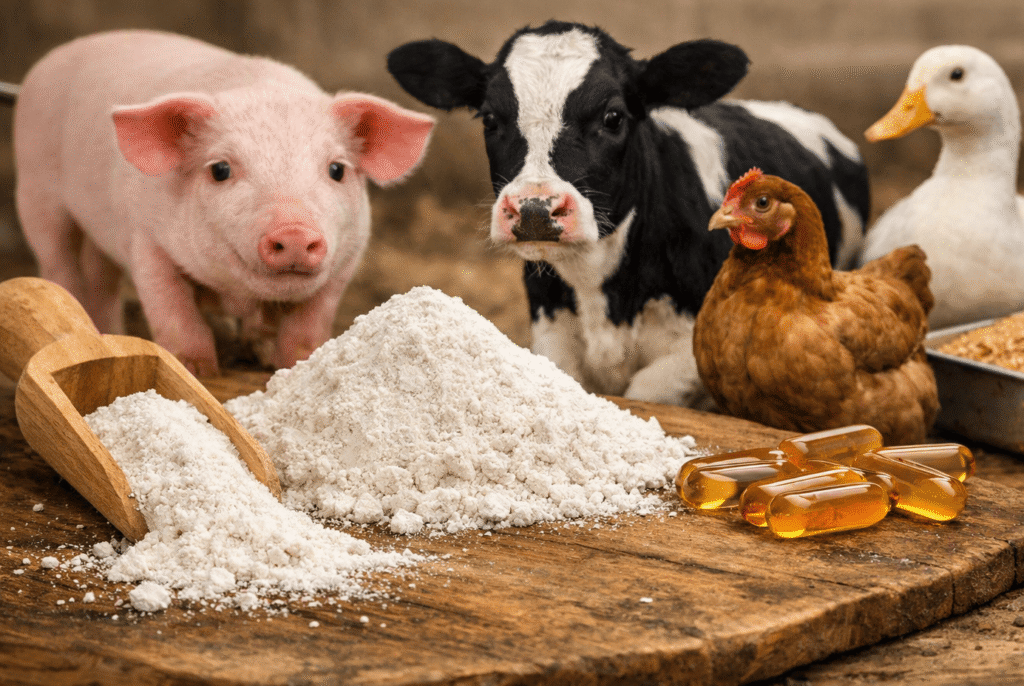
Why do livestock need pantothenic acid?
Farm owners often ask: Why do they need pantothenic acid if their diet already contains grain, protein components, and mineral supplements?
The answer is quite simple: a complete diet requires more than just energy and protein. Without sufficient vitamins, many physiological processes are less efficient.
Supplemental pantothenic acid is recommended during:
- intensive animal rearing;
- use of highly concentrated compound feed;
- periods of active growth of young animals;
- increased production loads;
- changes in diets;
- transportation of animals;
- building a breeding herd;
- raising high-yielding poultry.
Maintaining adequate vitamin supply is especially important in industrial livestock farming, where even a small deficiency can impact the economic efficiency of production.
Which animals are recommended to receive pantothenic acid?
Feed pantothenic acid is used in virtually all areas of animal husbandry.
It is most commonly used for:
- cattle;
- dairy cows;
- calves;
- pigs;
- piglets;
- sheep;
- goats;
- rabbits;
- poultry;
- turkeys;
- quail;
- ducks;
- geese.
For each animal species, the dosage is calculated by specialists based on the age, productivity, physiological condition, and feed composition.
When is vitamin B5 supplementation recommended?
Even a high-quality diet cannot always fully meet animals’ vitamin requirements.
Additional use of a feed supplement may be justified in the following situations:
- rapid growth of young animals;
- intensive fattening;
- beginning of lactation;
- laying period;
- post-vaccination stress;
- transition to a new feed;
- high animal density;
- seasonal changes in feed availability;
- long-term transportation;
- unfavorable housing conditions.
In all these cases, nutritionists recommend carefully monitoring vitamin balance.
Signs of Insufficient Pantothenic Acid
Vitamin B5 deficiency develops gradually. In the early stages, changes may be virtually unnoticeable.
Over time, the following signs may appear:
- Decreased appetite;
- Retardation of growth in young animals;
- Decreased feed conversion;
- Decreased productivity;
- Deterioration of skin condition;
- Brittle fur or feathers;
- Decreased vitality;
- Increased sensitivity to stress factors.
These symptoms are not specific to vitamin B5 deficiency, so final conclusions are made by specialists after a comprehensive assessment of the animals’ diet and living conditions.
How to Properly Use Pantothenic Acid in Feed
The most important rule is to use vitamin supplements only in the recommended amounts.
In practice, there are several methods of use:
- Incorporation into compound feed;
- Use in vitamin premixes;
- Addition to protein-vitamin-mineral concentrates;
- Use in compound feed mills;
- Use in the production of complete feed.
Increasing dosages independently does not improve feed efficiency and can lead to uneconomical use of the feed supplement.
The best results are achieved with a comprehensive balance of all vitamins and microelements.
Practical recommendations for use
To maximize the effectiveness of feed pantothenic acid, experts recommend following a few simple rules.
Before use:
- Assess the composition of the basic diet;
- Determine the age of the animals;
- Consider their physiological condition;
- Select a high-quality vitamin premix;
- Follow the manufacturer’s recommendations.
During use:
- Mix the supplement evenly with the feed;
- Do not exceed the recommended dosage;
- Monitor the quality of the feed;
- Observe storage conditions.
This approach helps maintain stable feeding and achieve predictable results.
Where to buy pantothenic acid for farm animals
If you plan to purchase pantothenic acid for the production of compound feed, premixes, or for use in livestock farming, it is important to choose a reliable supplier. The effectiveness of its use directly depends on the quality of the raw materials.
We, Globalchem LLC, supply feed ingredients and vitamin supplements to agricultural enterprises. Our product range includes high-quality pantothenic acid that meets industry requirements and is intended for use in compound feed and premixes.
Why choose Globalchem LLC:
- Products from trusted manufacturers;
- Consistent quality of every batch;
- A complete set of accompanying documentation;
- Assistance in product selection;
- Prompt order processing and timely delivery;
- Favorable terms of cooperation.
If you need to purchase pantothenic acid, Globalchem specialists will help you select the right product and offer optimal delivery terms for your business.
